What is DGUV §40 Commercial Diving? — What clients need to know
Anyone who commissions commercial diving work and professional diving in Germany bears responsibility, even if they do not enter the water themselves. The DGUV §40 Commercial Diving regulations set out clear requirements for equipment, qualifications, safety systems, and the organizational duties of all parties involved. Many clients underestimate the legal and operational consequences of hiring a non-compliant diving company.
This article gives you a factual overview: What does DGUV §40 regulate? What is the difference from the former BGR 237? And what should you, as a client, watch out for before awarding a contract?
What is DGUV §40 Commercial Diving?
The DGUV Regulation 40 “Diving Work” is the central accident prevention regulation issued by the German statutory accident insurance for commercial diving in Germany. It is published by the German Social Accident Insurance (DGUV) and is binding for all companies that carry out or commission diving work.
At its core, the regulation governs:
- Qualification requirements for professional divers and dive supervisors
- Minimum requirements for diving equipment and safety gear
- Organizational duties — from risk assessment to emergency planning
- Medical fitness of the divers deployed (G31 examination)
- Documentation requirements before, during, and after every dive
Violations of DGUV §40 are not merely a matter of fines. In the event of accidents, they can lead to full liability on the part of the client, especially if it is proven that a company was hired without the appropriate certification.
DGUV §40 and BGR 237 — What is the difference?
Many professionals know the term BGR 237 Diving — the former “Employer’s Liability Insurance Association Rule for Safety and Health at Work” specifically for diving operations. BGR 237 was the industry’s technical guideline for decades.
Today: BGR 237 was withdrawn as a standalone document and incorporated into the current DGUV regulatory structure. However, the substantive requirements of BGR 237 live on in DGUV Rule 103-005, which applies in addition to DGUV Regulation 40. When people today refer to “BGR 237 Diving,” in practice they mean the entire body of regulations comprising DGUV Regulation 40 and DGUV Rule 103-005.
For clients, this means: a qualified DGUV diving company must know and comply with both levels — the regulation and the supplementary rule.
What specifically must clients pay attention to?
As a client commissioning diving work, you are not a passive bystander. German occupational health and safety law, supplemented by DGUV §40, makes you part of the safety chain. This means specifically:
1. Selection of a certified diving company
Only commission companies that demonstrably work in accordance with DGUV Regulation 40. Request evidence of the qualifications of the professional divers deployed, current G31 examinations, valid liability insurance for diving work, and current equipment certificates.
2. Cooperation in the risk assessment
DGUV §40 requires that a site-specific risk assessment be prepared before every diving assignment. As the client, you are obligated to provide relevant information: water quality, contamination risks, current conditions, ground structure, and adjacent operational processes.
3. Access control and safety distance
During ongoing diving operations, the area around the dive site must be secured. This concerns not only the diving company but also your own operations: vessel traffic, running equipment, and other sources of interference must be coordinated.
4. Emergency management
A diving company operating in accordance with DGUV §40 brings its own emergency plan, but as the client, you need to know how to respond on your end: Who alerts whom? Is there a nearest decompression chamber? Are your safety officers informed?
In which industries does DGUV §40 Commercial Diving apply?
DGUV §40 Commercial Diving applies wherever professional underwater diving work is carried out, regardless of industry or water depth. This includes, among others:
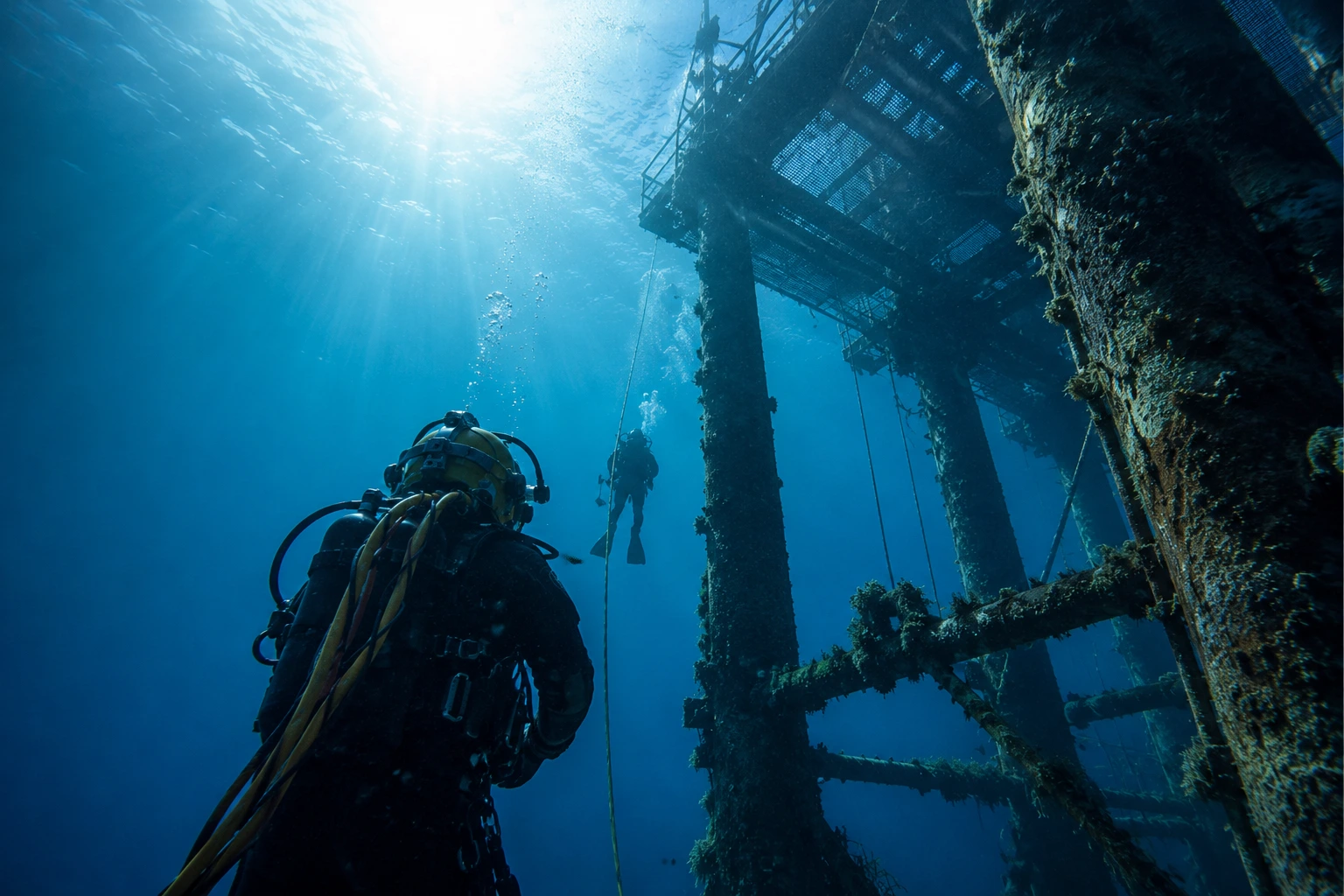
- Industrial underwater work: Inspection and maintenance of cooling water systems, power plant intakes, and offshore structures → Industry & Energy diving services from TUF International
- Civil engineering & infrastructure: Bridge inspection, sheet pile inspection, foundation work underwater → Civil Engineering & Infrastructure diving services from TUF International
- Chemical facilities: Diving operations under contamination conditions, tank inspections, HSE-compliant work → Chemical Facility diving services from TUF International
- Water & wastewater: Inspections in treatment plants, water tanks, pressure pipelines, and pumping stations → Water & Wastewater diving services from TUF International

- Ports & harbor construction: Underwater work on quay walls, piles, locks, and port facilities → Ports & Harbor diving services from TUF International
The same legal basis — and the same responsibility for the client — applies across all of these areas.
The DGUV badge — what’s behind it?
The DGUV test mark on equipment and working according to DGUV-compliant processes are not marketing claims but legally anchored requirements. A reputable DGUV diving company can provide evidence on request at any time, covering diver qualifications, equipment inspections, and completed risk assessments.
When awarding a contract, look out for the following quality signals:
| Criterion | What you should check |
|---|---|
| Diver qualification | CMAS ★★★ commercial diver or national equivalents |
| Medical fitness | Current G31 certificate for all divers deployed |
| Safety equipment | Helmet/full-face mask system, standby diver, communication system |
| Documentation | Diving log, risk assessment, emergency plan |
| Insurance | Business liability insurance with coverage for diving work |
Conclusion — Why choosing the right diving company is crucial
DGUV §40 Commercial Diving is not bureaucratic window dressing, it is the foundation for safe, legally compliant, and properly insured underwater work. As a client, you share responsibility for ensuring that only certified, qualified companies are engaged.
TUF International operates according to the requirements of DGUV Regulation 40 and the supplementary DGUV Rule 103-005, across all industries, at all locations, with complete documentation and experienced professional divers.
Do you have a project that requires diving work? Contact us for a no-obligation consultation.